A Simple Journey to the Cloud…
This week, I finished up a series of road-shows and it was reminiscent of “engagements” that I did years ago…
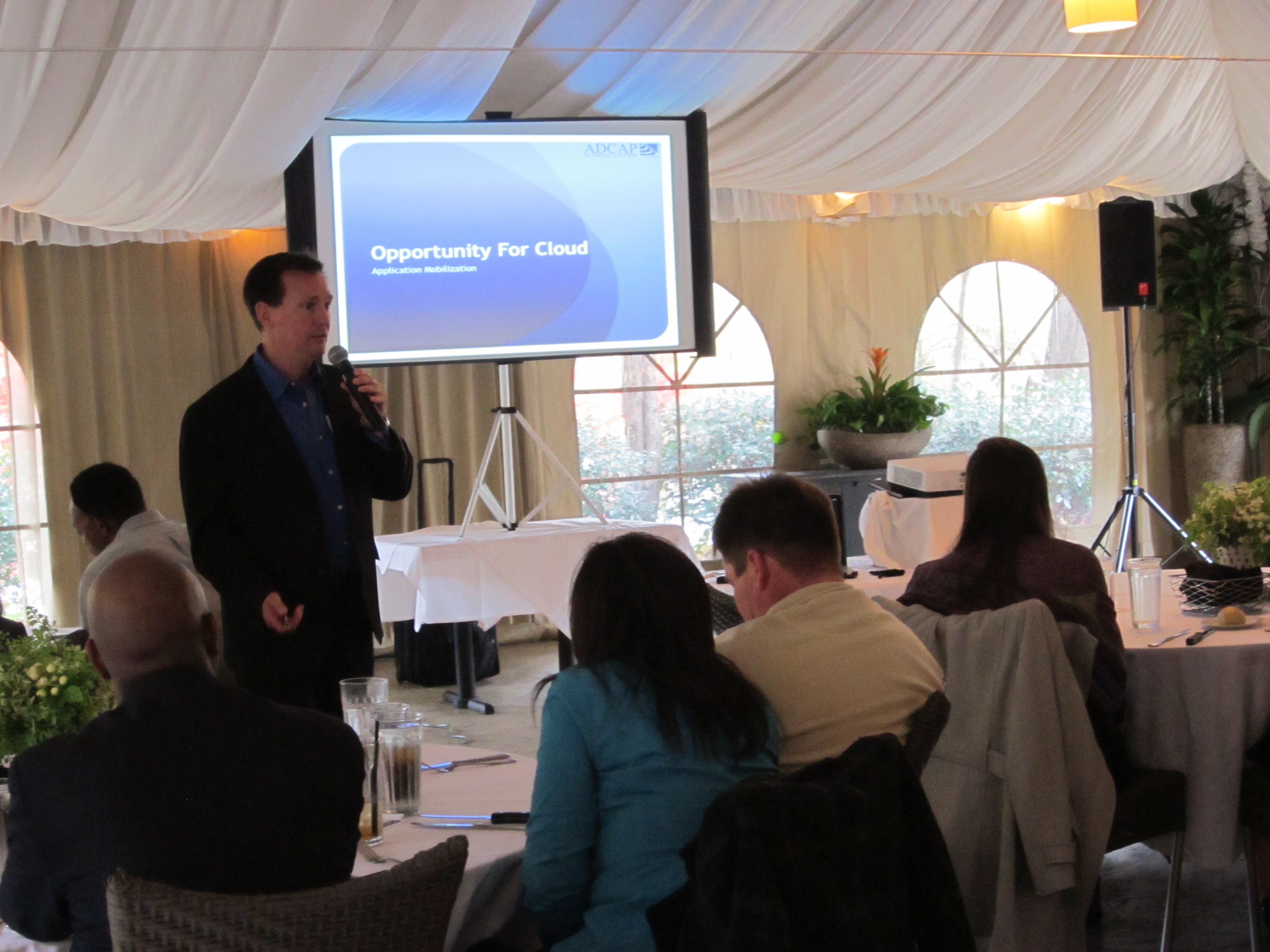
Customer Event 14Nov12 Atlanta
As I sat down and started building my message and the presentation, I remembered how important Data Center Optimization really was, and how often it was left behind. The framework that I created years ago still lives on as a guidepost to the areas that must be addressed if you are going to build a true cloud strategy and achieve the results that so many desire. Ironically enough, I can’t stop myself from thinking, what’s old is new again!
Let’s start this conversation with what is relevant with every IT manager, at any level (C,V,D,M), and that is always top of mind…COSTS. Cost constraints in IT are always top of mind, unless you are in the business of technology/technology is your business. “Do more with less, do more with what we have…just do more, but with no additional budget…” these are the conversations that we commonly hear through-out the year, especially during budget planning seasons.
The inverse to these conversations, which I am still glad to hear happen, are “IT – keep us competitive, give us speed to market, allow our users the ability and freedom to roam and work on their time to support our customers…” All while maintaining security, reliability, and up-time. These are the conversations we should all love to have, because they support the health and growth of the customer, beyond the day to day cost and operational conversations.
Conversations like this bring cloud, specifically PRIVATE CLOUD, to the front table as companies look at ways to provide the business with the flexibility they so badly desire. Confused on Private Cloud (I find sales reps are…) Private Cloud is the “intersection of virtualization and cloud technologies…” Tom Bittman, VP Gartner – has a great video to frame this…
[embedplusvideo height=”388″ width=”640″ standard=”http://www.youtube.com/v/ZAbFR9A1XmY?fs=1″ vars=”ytid=ZAbFR9A1XmY&width=640&height=388&start=&stop=&rs=w&hd=0&autoplay=0&react=1&chapters=¬es=” id=”ep3743″ /]
“It’s a Private Cloud we desire, but it’s a legacy infrastructure that holds us back…” Frank Ball
With the advent of High-Availability and Fault Tolerance in Virtualization tools, more and more organizations are migrating physical work-loads to virtual. As they “cross this chasm,” they are looking forward into the future for Automation, Orchestration, and self-service models to support the business (aka – Private Cloud).
But herein lies the problem. Most companies jumped feet first into this pool called “virtualization,” and they forgot a lot of things along the way. Left behind were critical areas of savings that could have benefited the organization and potentially funded the acceleration of the “Journey to the Cloud…” Combine that with aged infrastructure that is not “Cloud Ready,” and IT services, processes and even people that aren’t aligned appropriately. Well, we seem to have one foot stuck in the past as we try to look forward to the future. Not only is it costing us a LOT of money to support all of this “stuff,” but we aren’t really giving the business what they asked us for to begin with.

The 7 areas of Optimization?
1 – Applications
2 – Operating Systems
3 – HyperVisor Selection
4 – Platform Selection
5 – Networking and Security (virtualization and consolidation)
6 – Storage (virtualization and consolidation)
7 – Business Continuity and Disaster Recovery Planning
These areas need to be addressed when we first set out on the path to virtualization. Not just for cost saving, but to gives us the foundation to be able to provide true self-service models through Automation and Orchestration.
But most of us grabbed a hyper-visor and starting “playing” with workloads to solve a specific problem…Data Centers/Infrastructure was growing at an alarming rate, and we were running out of space… So we looked to virtualization to solve our “platform consolidation” problems. Although servers were a big part of the equation, they weren’t the only piece to consider. We still needed to address the “pipes, plumbing, and hot water heater.”
Network Consolidation and virtualization can contribute a 25% cost savings by migrating from “old to new.”
Storage Consolidation and virtualization can contribute a 50% cost by migrating from “old to new.”
Whether you are a VAR or a Manufacturer reading this posting, you understand the fundamental challenge…I need to get me more market-share for my products and services while customers grapple with this confusion in the market place.
I agree – and I also think that it makes “Call To Action” incredibly relevant to your business.
If you are a business partner and your reps aren’t having these types of conversations with your customers…well, chances are your competition is… Put 50 target customers in a room and let us have this conversation “with” you. Let us take you on a journey with your business partners to build quantifiable opportunities that are ready to engage and buy from you. Let us expand your opportunities and investments.
Consider this…
Are your sales reps able to understand these items in a way that they can have a framing conversations with your customers, and create net new opportunities? Let us make them a part of this process so they can “learn, see, do.”
The two events we just completed yielded a 50% hit rate on our “Call To Action” for our customer. That is 50% of the participating customers opting in for a “Journey to the Cloud,” being delivered by our customer (a reseller partner). Our service just generated net new opportunities for our customer’s vested manufacturers that they will be able to develop into “registered” deals, providing more margin while blocking their competition. Additionally, they have tighter processes in place to pursue these opportunities with a higher-rate of success then they did just 7 short weeks ago.
We captured what the customers “want to hear about next” – solidifying investments and opening up new pathways for future investments.
Let this be your “Call To Action.” Opportunities are there, ready and waiting for you. Are you ready for them?
 10400 Old Alabama Road Connector
Suite 115
Alpharetta, GA 30040 USA
Canadian Headquarters
10400 Old Alabama Road Connector
Suite 115
Alpharetta, GA 30040 USA
Canadian Headquarters  4341 Harvester Road
Burlington, Ontario L7L 5M4 Canada
4341 Harvester Road
Burlington, Ontario L7L 5M4 Canada
COMMENTS
There are no comments yet.